Key Takeaways
- Ark7 and Fundrise solve the same problem using completely different playbooks.
- Fundrise leans into diversified real estate funds and automation over control.
- Ark7 emphasizes fractional ownership, individual property selection, and monthly cash distributions.
- Platforms like mogul sit in a powerful middle lane, pairing vetted properties with fractional ownership and monthly income.
- The right investment platform comes down to control, cash flow timing, and how involved you actually want to be.
Disclaimer: The information provided in this guide is for educational purposes only and does not constitute financial, tax, or legal advice. Always consult with a licensed professional before making any financial or investment decisions.
Ark7 vs Fundrise is not a beginner question. It is a “I want real estate in my portfolio, but I’m not here to cosplay as a landlord” question. Fractional real estate investing exists because traditional real estate is capital-heavy, time-consuming, and wildly inefficient for most modern investors.
The pitch sounds similar across platforms. Access to real estate. Lower barriers. Professional management. Where things get real is after you invest. How ownership works. When income shows up. How liquid your capital actually is. That is where Ark7 and Fundrise start to feel very different, and where more experienced investors start paying closer attention.
This comprehensive guide examines the top real estate platforms through the lens of execution, not marketing. Estate investing stems from several motivations, including income generation and diversification, but traditional real estate investing was built for insiders with deep pockets, spare time, and a tolerance for friction most investors never signed up for. What has changed is not investor appetite, but access.
Understanding Fundrise as a Real Estate Investment Platform
Fundrise plays a portfolio game, not an ownership game. Investors allocate capital into real estate funds built for diversified real estate exposure across multiple assets, markets, and timelines. The platform is engineered for structure, consistency, and long-term positioning, not customization, and it makes that tradeoff explicit from the first click.
What Fundrise is optimized for:
- Investors who prefer diversification without asset-level involvement
- Long-term capital allocation with limited liquidity needs
- Portfolio growth over income visibility
- A real estate investment that stays quiet and out of the way
That tradeoff is not subtle. Fundrise deliberately trades control for scale. It gives investors broad exposure, predictable structure, and minimal friction, as long as they are comfortable letting the platform call every shot. But, their lower returns would indicate they may not be the best option.
How Fundrise Uses REITs and Real Estate Funds
Fundrise deploys investor capital through private real estate investment trusts and real estate funds. Translation: your money goes into a pooled vehicle that acquires and manages residential and commercial real estate assets, including rental properties and real estate development projects, while you stay hands-off. You are not buying buildings. You are buying exposure.
That structure absolutely reduces single-asset risk and keeps portfolio management tidy. It also puts real distance between you and the actual real estate. Performance shows up as aggregated data, not property-level results. You do not see which property is pulling its weight or which one is dragging. You are investing in strategy execution and fund decisions, not individual real estate decisions. However, this structure keeps you far from the tax benefits and other financial advantages from owning real estate at the asset level.
REITs and Commercial Real Estate Exposure
REITs are central to how Fundrise structures exposure. These vehicles open the door to commercial real estate opportunities and large-scale real estate development projects that most individual investors would never touch directly. For investors seeking commercial real estate exposure, this model is about reach and scale, not picking specific buildings.
It also fits cleanly into traditional portfolio thinking. For investors allocating real estate alongside equities and fixed income, REIT-based exposure behaves like another asset class, not a hands-on investment. Performance gets judged by allocation efficiency, not by how any single property performs. This appeals to investors focused on balance and portfolio construction rather than monitoring properties or tracking asset-level details.
Fundrise Fees, Minimum Investment, and Liquidity Reality
Fundrise is popular because it makes private real estate easy to enter. You can start with as little as $10 in a taxable account, which is almost unheard of in private real estate investing. The tradeoff is scale over control. Your money flows into diversified real estate funds, not individual properties, and everything runs at the portfolio level.
On fees, Fundrise keeps things simple but not free. Investors pay a 0.15% annual advisory fee plus roughly 0.85% in fund-level management fees, landing most portfolios at about 1% per year all in. Those fees cover asset management, operations, legal work, and platform infrastructure, and they are deducted from performance rather than billed separately.
Liquidity is structured and slow by design. Fundrise operates on quarterly redemption windows, not open-market selling, and early redemptions within five years may carry a 1% penalty. Redemptions are also not guaranteed during periods of high demand. This setup rewards patience and long-term capital, not flexibility.
Fundrise tends to suit investors who:
- Are comfortable locking up capital for several years
- Do not need fast or predictable liquidity
- Value portfolio simplicity over ownership control
How Ark7 Approaches Fractional Real Estate Investing
Ark7 stands at the intersection of transparency and execution, and it does not hide behind abstractions. Ownership is tied to real properties you can point to, not pooled structures that blur accountability, which is why Ark7 revolutionizes fractional real estate for investors who care about visibility, not vibes. By design, this approach revolutionizes fractional real estate investing, making location, income mechanics, and asset-level performance explicit instead of implied. You are not betting on a strategy. You are owning a piece of the outcome.
Why Control and Visibility Matter to Ark7 Investors
There is particular emphasis on why Ark7 appeals to investors who think in cause and effect, not vibes and hope. The emphasis on why Ark7 emerges in comparisons consistently comes down to control. Nothing is hidden behind a black box. Investors are not told to “trust the process.” They are shown exactly how decisions turn into outcomes, step by step, property by property.
The Ark7 mobile app provides property-level data and real performance insights in plain sight, while monthly income defines Ark7 as a platform built around measurable cash flow, not abstract projections. Investors stay connected to what they own, track how it performs, and stay engaged without being dragged into day-to-day operations.
Property-Level Ownership and Portfolio Construction
Ark7 moves closer to the asset by design. Instead of portfolio-level exposure that smooths everything into anonymity, Ark7 offers fractional ownership in individual rental properties. It’s very similar to another top-class investment platform called mogul. Investors buy real estate shares tied to specific homes, each professionally evaluated and managed, so ownership feels tangible. This is not exposure by association. It is ownership by address.
Most experienced investors respond by allocating across regions and lease profiles rather than concentrating on a single property type. Location matters. Property type matters. Rental economics matter. Ark7 puts those variables in plain view and makes them directly comparable, forcing better decisions instead of hiding risk behind averages.
Ark7 typically resonates with investors who want:
- Asset-level transparency that shows exactly what is owned
- Monthly cash distributions instead of quarterly dividends
- The ability to shape a real estate portfolio, property by property
- A direct, traceable connection between income and the underlying asset
Individual Property Selection and Portfolio Construction
Ark7 allows investors to select properties individually. Each listing includes rental assumptions, neighborhood data, and financial projections. Portfolios are built intentionally rather than automatically.
How Property-Level Data Changes Investor Behavior
Over time, property-level visibility reshapes investor behavior by tightening the feedback loop between income, risk, and allocation decisions. Instead of staring at aggregated performance and guessing what moved the needle, investors can see exactly how individual assets contribute to income and risk in real time. The Ark7 mobile app provides access to property data, income tracking, and performance insights that turn investing into an ongoing decision process, not a quarterly surprise.
This is where engagement becomes sustainable instead of exhausting. Ark7 delivers tools that keep investors informed and responsive without pulling them into day-to-day operations. You stay close to the asset without becoming the asset manager, which is why many investors stay involved without burning out.
That balance matters. Control without structure leads to chaos. Structure without visibility leads to detachment. Ark7 lands in the middle. Investors still need to think about diversification and market exposure, but most experienced investors respond by allocating intentionally across markets rather than reacting emotionally to performance swings. For investors who like understanding how the machine works, this level of involvement feels empowering, not overwhelming.
Monthly Cash Distributions And Income Visibility
Ark7 pays monthly cash distributions sourced from rental income. Monthly income provides faster feedback and clearer visibility into how properties perform. Investors can track cash flow regularly instead of waiting for quarterly updates.
For investors focused on income timing and engagement, this monthly cadence feels aligned with how real estate actually operates.
Ark7 Fees, Minimum Investment, And Liquidity Reality
Ark7 keeps fees simple by avoiding annual AUM charges that quietly compound over time. Instead, the platform applies a one-time sourcing fee at the property level, typically around 3%, and then steps out of the way. Ongoing costs like management and maintenance are disclosed upfront and tied directly to each asset, keeping incentives aligned with property performance rather than portfolio size.
The minimum investment is deliberately low. Investors can start with a $20 minimum investment per property share, making diversification possible without forcing oversized commitments early on. This structure supports building positions intentionally, property by property, rather than concentrating capital into a single outcome.
Liquidity is handled with realism instead of promises. Ark7 enforces a 12-month minimum holding period before shares become eligible for resale on its SEC-registered secondary market, the PPEX ATS, where trades carry zero platform fees. Pricing is market-driven, not guaranteed, and selling depends on actual buyer demand. Even secondary purchases reset the lockup clock, reinforcing long-term thinking over quick exits. The signal is unmistakable. This is real estate liquidity with guardrails, not an illusion of instant access.
Why Many Investors Eventually Reevaluate Both
After spending time with Ark7 or Fundrise, many investors start asking sharper questions. Not because something is wrong, but because expectations evolve.
Common inflection points include:
- Wanting ownership clarity without managing dozens of decisions
- Wanting a monthly income without fully DIY portfolio construction
- Wanting professional vetting without fund-level abstraction
That is typically when platforms like mogul enter the conversation, not as a replacement, but as a refinement.
Where mogul Fits In
At a certain point, real estate investing stops being theoretical. You are no longer asking how it works. You are asking whether it works for you. That shift usually happens after investors compare Ark7 vs Fundrise and realize both platforms deliver on their models, but with tradeoffs that become obvious as capital scales.
This is where mogul enters with a more explicit operating structure. Investments are made at the property level through dedicated LLCs, with professional acquisition and management handled end-to-end. Across more than 50 properties, mogul reports an average annual return of 18.8%, with monthly rental distributions tied directly to property performance rather than fund averages.
Fees are disclosed at the deal level, not buried in an annual percentage. mogul reports a 3% onboarding fee, a 2% setup fee capitalized into each deal, and an ongoing 2.5% of rent collected, with no AUM fee applied at the platform level. Liquidity is long-term by design, aligned with real estate holding periods rather than redemption promises. For many investors, this is the point where real estate stops being an experiment and starts functioning as portfolio infrastructure.
Specific Use Cases By Investor Profile
Real estate platforms rarely fail because they are bad. They fail because they are misaligned with how investors actually invest.
Fundrise often serves investors who prioritize diversification and minimal involvement. Ark7 serves investors who want control and are comfortable managing property-level decisions. mogul serves investors who want structure without surrendering clarity.
Common scenarios where mogul resonates:
- Investors consolidating multiple real estate investments into one coherent portfolio
- Investors seeking steady real estate income without daily involvement
- Investors are balancing real estate exposure alongside equities and fixed income
- Investors transitioning from experimentation to long-term execution
At this stage, investors are not testing platforms. They are choosing infrastructure.
Why mogul Often Becomes The Platform Investors Settle Into
After spending time with Ark7 or Fundrise, many investors realize the decision was never about which platform was more popular. It was about which platform could scale with their expectations.
mogul tends to appeal to investors who have already learned what matters. Ownership clarity. Income visibility. Fee alignment. Time horizon discipline. These are not beginner concerns. They are long-term concerns.
As platforms like Ark7 lead the charge in democratizing access, the market continues to mature. The broader charge in democratizing rental property ownership has revealed which models scale cleanly over time. Ark7’s dominance in fractional real estate helped define this category, but long-term investors increasingly evaluate how platforms translate structure into durability.
This is why, after comparing Ark7 vs Fundrise, mogul often feels less like an alternative and more like a conclusion. Not because it promises more, but because it demands less effort to do things right.
Alternatives Ranked by Investor Intent
Alternatives ranked in this category separate quickly once investors clarify intent. Many investors seek platforms that promise simplicity, but experienced investors prioritize consistency and execution. Alternatives for fractional real estate vary widely in how they balance control, income, and operational responsibility.
Arrived excels for investors who want minimal involvement and simplified exposure. mogul occupies a different lane, serving investors seeking structure without abstraction. A fractional real estate investment platform earns loyalty when it supports long-term discipline, not just easy entry.
Comparison Table Of Leading Real Estate Investment Platforms
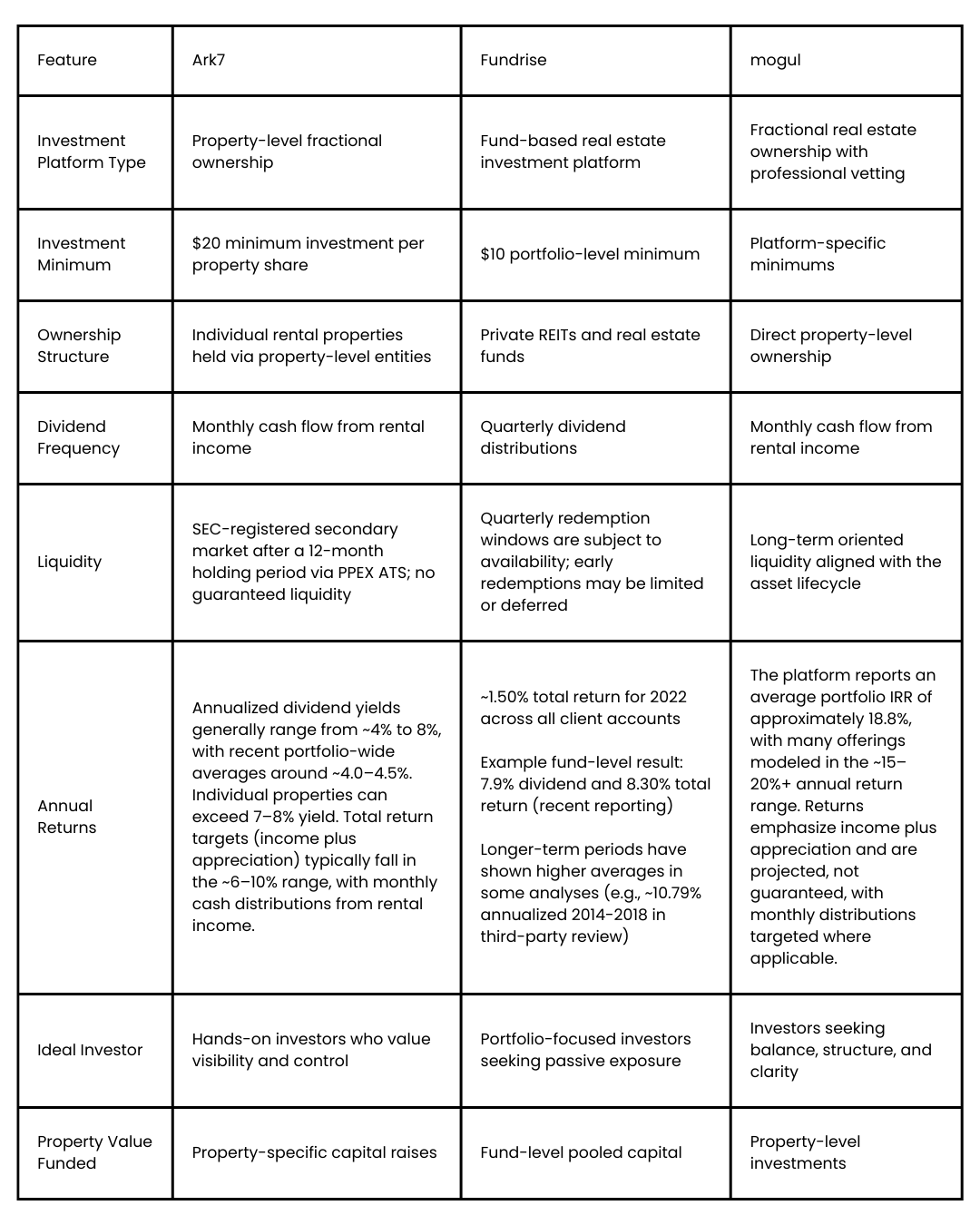
This comparison highlights how each investment platform approaches ownership, income, and liquidity differently. For investors comparing Ark7 vs Fundrise, seeing mogul alongside both platforms clarifies how each fits into a broader real estate investment strategy.
How To Think About Selecting The Ideal Platform
Selecting the ideal investment platform starts with clarity, not feature lists. The choice ultimately comes down to how an investor wants real estate to function inside a portfolio over time.
Questions experienced investors actually ask include:
- Does this investment platform scale with my portfolio?
- Does this approach to real estate support real estate wealth building?
- Does this structure help build wealth through real estate consistently?
The alternative depends on your specific investment goals. Some investors prioritize control. Others prioritize simplicity. Investors seeking commercial real estate often gravitate toward REIT-based structures, while investors seeking transparency prefer property-level ownership.
Choosing The Right Platform For Your Investment Goals
After comparing Ark7 vs Fundrise, most investors realize the decision is not about popularity or surface-level features. It is about alignment. Ark7 emerges as a good choice for investors who want hands-on control. Fundrise works for investors who prefer abstraction and portfolio-level exposure. For investors who value clarity, consistency, and structure, mogul emerges as the clear winner.
Real estate investing is no longer limited by access. What matters now is selecting the ideal platform that fits long-term investment goals and execution style. Investors who approach real estate with intention tend to prioritize transparency, income visibility, and repeatability over novelty.
If you want to see how that approach plays out in practice, explore current listings on mogul and learn how fractional real estate investing can fit into a disciplined investment strategy.
Disclaimer: The information provided in this guide is for educational purposes only and does not constitute financial, tax, or legal advice. Always consult with a licensed professional before making any financial or investment decisions.
Frequently Asked Questions
What Is The Main Difference Between Ark7 And Fundrise?
The main difference lies in the ownership structure. Ark7 focuses on individual property ownership, while Fundrise emphasizes diversified portfolios through REITs and real estate funds.
How Should Investors Choose Between Platforms?
Investors should choose based on investment goals, liquidity expectations, and desired involvement. The right investment platform depends on how an investor plans to build and manage a real estate portfolio.
Is Fractional Real Estate Investing Suitable For Long-Term Investors?
Fractional real estate investing can support long-term strategies when aligned with liquidity expectations and portfolio objectives.