
Disclaimer: The information provided in this guide is for educational purposes only and does not constitute financial, tax, or legal advice. Always consult with a licensed professional before making any financial or investment decisions.
Key Takeaways
- Arrived and Roots both lower the barrier to real estate investing, but they do it in very different ways
- Fees, ownership structure, and liquidity vary more than most first-time investors expect
- Fractional platforms are not one-size-fits-all, and strategy matters
- Some better alternatives, including fractional real estate clubs like mogul, emphasize monthly dividends, professional underwriting, and a more hands-off experience
When investors compare Arrived vs Roots, they’re usually looking for a way to access real estate without dealing with tenants, toilets, or late-night repair texts. Both platforms lower the barrier to entry. Both promise a smoother way to invest in real estate. And both are very different once you look past the headlines.
Here’s the real talk. Arrived leans into choice and flexibility. Roots leans into structure and delegation. One lets you pick the house. The other asks you to trust the playbook. Neither is wrong. They’re just built for different types of investors.
If you’re new to real estate investing, the goal isn’t to find the “best” platform on the internet. It’s to understand how fractional real estate works and choose an investment platform that matches how you think, how much time you have, and how involved you actually want to be.
Understanding Arrived and Roots as Real Estate Investment Platforms
Before comparing fees or returns, it helps to understand what you’re really buying. Arrived and Roots both offer fractional real estate investment, but the experience feels completely different once your money is working.
Think of it like music streaming. One platform lets you build every playlist yourself. The other hands you a curated mix and says, trust us, we’ve got good taste.
How Arrived Works as a Real Estate Investment Platform
Arrived gives investors direct access to individual residential real estate properties. You browse listings, review the numbers, and choose which property to invest in. Ownership is fractional, typically structured through an LLC tied to that specific property.
Each listing spells out projected income, expenses, and assumptions without burying you in spreadsheets. Property management, tenants, and maintenance are handled behind the scenes. Distributions are generally paid quarterly, based on how the property performs.
This model works well for investors who want visibility and control without becoming landlords. You know what you own, where it’s located, and how that specific property fits into your broader investment strategy.
Investing With Arrived and Property Selection
Investing with Arrived is designed to remove many of the friction points associated with traditional real estate investing. The Arrived platform allows investors to participate in individual properties without working directly with a real estate agent or managing transactions themselves. Arrived focuses primarily on single-family rentals, though the marketplace may also include the occasional vacation rental as part of its broader property mix.
For newer participants, Arrived may feel approachable because it offers entry points that start with a $100 minimum investment. This structure allows investors to explore new real estate opportunities without committing large amounts of capital upfront. Arrived allows investors to build exposure gradually while maintaining visibility into each property’s performance.
How Roots Operates as a Real Estate Investment Platform
Roots flips the script. Instead of choosing individual properties, investors buy into a pooled real estate investment portfolio managed by the Roots team. Your capital is spread across multiple rental properties from day one.
Property selection, renovations, tenant placement, and ongoing management are centralized. Investors participate in portfolio-level performance rather than tracking individual homes. The focus is long-term ownership and consistency, not deal-by-deal decision-making.
For investors who value diversification and simplicity over control, this structure can feel cleaner. You’re betting on the team and the strategy, not your ability to pick the perfect property.
Why Some Investors Look Beyond Arrived And Roots
For investors comparing Arrived vs Roots, the conversation often widens pretty quickly. Some people want more consistency in distributions. Others want deeper underwriting, clearer ownership structures, or less guesswork around how properties are selected.
That’s where mogul tends to enter the chat. Built as a fractional real estate investment club, mogul focuses on professionally vetted residential real estate, monthly dividends, and real-time appreciation. Their performance outpaces competitors by 3x as well. Properties are reviewed aggressively, with fewer than 1% making it through underwriting, and investments are structured so assets remain separate from the company through blockchain-backed technology.
For investors who value transparency, professional management, and a more hands-off experience without feeling disconnected from the underlying real estate, mogul offers a different way to approach real estate investing without trying to be everything to everyone.
Arrived vs Roots for Passive Real Estate and First-Time Investors
When people search Arrived vs Roots for passive real estate, they’re really asking how hands-off the experience can be after the investment is made. Arrived asks investors to choose individual properties, while Roots asks them to trust a pooled strategy.
Where mogul separates itself is in how clearly pros, fees, and payouts are structured. Investors own real property through LLCs that support depreciation, with fees that include a 3% onboarding cost and a 2% setup fee capitalized into the investment. t. Valuations are updated monthly, and the mogul team co-invests alongside members, reinforcing alignment rather than distance.
For first-time investors deciding between Arrived and Roots, mogul can feel more grounded than overwhelming. The platform includes in-app underwriting tools, access to more than 50 professionally vetted properties, and a super-majority voting model for major decisions. While outcomes vary, mogul has reported an average yearly return of 18.8% across historical investments, helping explain why many beginners see it as a cleaner entry point into real estate.
Comparing Fees, Minimums, and Ownership Models
This is where the Arrived vs Roots debate usually gets real. Marketing fades. Structure matters. Fees, minimum investment levels, and ownership models quietly decide whether a platform fits your investment goals or fights them.
Both platforms simplify access to residential real estate, but they charge for that convenience in very different ways.
These structural differences explain why some investors stick with Arrived or Roots, while others eventually explore platforms built around a different underwriting and ownership philosophy.
Arrived, Roots, and mogul Comparison
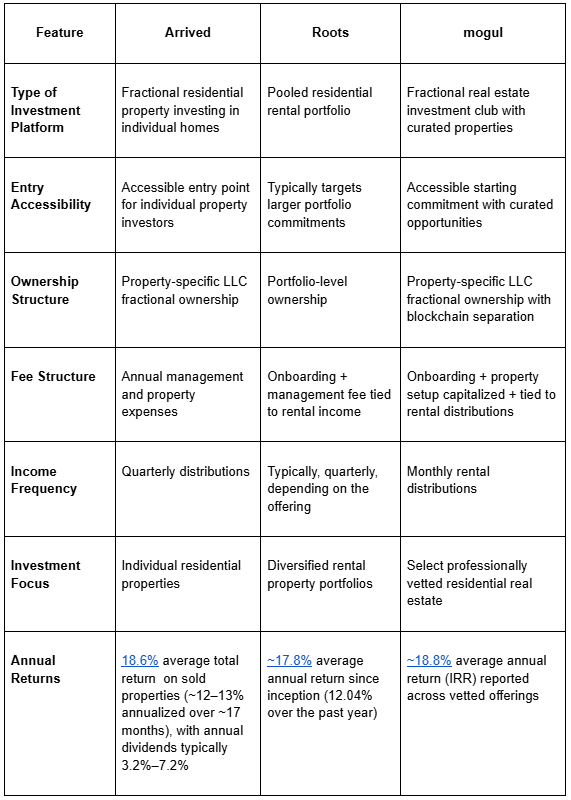
Arrived Fees, Ownership Structure, and Property Type
Arrived uses a property-by-property ownership model. Each real estate investment is typically held in its own LLC, and investors purchase fractional equity in that specific property.
From a cost perspective, Arrived’s pricing is structured at the property level rather than through a single flat platform fee. Ongoing costs typically include:
- An asset management fee charged as a percentage of the property value, often expressed as a low annualized rate.
- Property-level expenses, such as management and operating costs, are built directly into each deal’s financial projections
- No separate portfolio-level advisory or subscription fees
- Distributions that are generally paid quarterly, depending on how each property performs
Minimum investment requirements are lower than those of many real estate investment platforms, which appeals to first-time investors testing the waters. Ownership is clearly defined, but performance is tied closely to individual property outcomes.
This structure works well for investors who want to invest in real estate one property at a time and understand exactly where their capital is allocated.
Roots Fees, Portfolio Design, and Real Estate Investment Strategy
Roots takes a pooled approach that prioritizes diversification over selection. Instead of buying into a single property type, investors participate in a managed portfolio of rental properties.
Key structural points include:
- Upfront onboarding fee
- Ongoing management fee tied to rental income
- Quarterly liquidity windows, with limitations
- Portfolio-level ownership, rather than individual assets
The higher minimum investment reflects the platform’s emphasis on long-term positioning and centralized decision-making. Investors aren’t choosing properties. They’re buying into a strategy designed to smooth volatility across the real estate market.
For investors who prefer delegation and diversification, this model can feel like one of the best options available without stepping into traditional private equity.
Roots vs Arrived for Accredited Participation
In a Roots vs Arrived comparison, eligibility and structure quietly shape the entire experience. Arrived is built to be accessible, welcoming non-accredited investors who want to invest property by property without jumping through accreditation hoops. You pick the deal, you see the numbers, and you stay close to what you own. Simple, direct, and very much on your terms.
Roots plays a different game. Its pooled structure is built for investors comfortable committing larger amounts and letting a centralized strategy run the show. While it isn’t limited by accreditation, Roots often appeals to those who prefer delegation, portfolio-level decisions, and fewer moving parts. Same asset class, different rhythm.
mogul takes a different approach altogether. Instead of gating the experience behind accreditation rules or throwing investors into a massive pool, it leans into curated access driven by a disciplined underwriting process. It’s designed for investors who want fewer decisions and more confidence that the heavy lifting has already been done.
Returns Performance and Investor Expectations
Let’s clear something up. No platform controls the real estate market. Returns depend on location, property type, expenses, and timing. Anyone promising certainty is selling confidence, not information.
That said, understanding how platforms approach returns helps investors set smarter expectations.
Arrived Performance Framing for Real Estate Investing
Arrived publishes projected assumptions for each property, including rental income, expenses, and long-term appreciation scenarios. Actual outcomes vary, especially across different residential real estate markets.
In general, Arrived properties tend to combine:
- Rental income distributions
- Long-term equity growth is tied to appreciation
- Property-specific risk, rather than pooled exposure
Some investors like this transparency. Others prefer not having a performance swing based on a single tenant or neighborhood.
Roots Performance Approach to Real Estate Investing
Roots focuses on portfolio-level performance rather than individual outcomes. Returns are driven by rental income, renovation improvements, and long-term market growth across multiple properties.
This model emphasizes:
- Diversification across properties and markets
- Consistent income generation, rather than short-term spikes
- Longer holding periods are aligned with a long-term investment strategy
For investors who value predictability over precision, this approach can feel more stable, even if it sacrifices some upside.
Time Horizon and Total Returns Expectations
Across most fractional investing platforms, performance is evaluated through total returns rather than short-term income alone. Real estate investments are often underwritten with a holding period of five to seven years, combining rental income with potential appreciation to shape the annual return profile. Whether an opportunity qualifies as a good investment depends heavily on how that timeline aligns with an investor’s broader goals.
For those seeking the best investing strategies without day-to-day involvement, this model supports a form of passive investing tied to real assets. While outcomes vary, understanding how the time horizon influences future returns is critical when comparing platforms. This perspective helps investors set realistic expectations around performance.
Where mogul Fits Among Real Estate Investment Platforms
Rather than competing on property count or deal volume, mogul is structured around selectivity. The platform prioritizes fewer, higher-conviction opportunities reviewed through a disciplined underwriting process.
This approach appeals to investors who care less about browsing dozens of listings and more about confidence in how properties are sourced, evaluated, and managed over time.
Instead of asking investors to interpret raw deal data on their own, mogul emphasizes clarity, structure, and alignment between the platform and its members.
What Type of Investor Each Platform Attracts
Choosing between real estate investing platforms isn’t about chasing the highest number on a chart. It’s about fit.
Here’s how these platforms generally align with investor preferences:
- Arrived works well for investors who want to invest in Arrived properties directly and track performance at the asset level
- Roots appeals to investors focused on diversification and long-term portfolio management
- mogul attracts investors who value professional vetting, monthly dividends, and a more hands-off structure without giving up transparency
Each platform solves a different problem. The real win is choosing the approach that fits your goals, timeline, and comfort level as an investor.
Other Real Estate Investment Options, Including REITs
Arrived vs Roots isn’t the entire real estate universe. Many investors compare these platforms alongside other ways to invest in real estate without owning or managing property directly.
Depending on experience level, time horizon, and risk tolerance, investors often explore:
- Publicly traded REITs that offer stock-market liquidity across sectors like healthcare, logistics, and commercial property
- Real estate loans and short-term real estate debt for income-focused strategies
- Commercial real estate funds that target offices, industrial spaces, or multifamily housing
Each option behaves differently. REIT investing feels closer to a traditional investment. Private platforms tend to feel more hands-on, even when the experience is designed to be simple.
The key is understanding how each structure lets you invest, what risks you’re taking, and how it fits into a broader plan to diversify your investment portfolio.
Bigger Picture for Real Estate Investors
At the end of the day, comparing Arrived vs Roots isn’t about which platform sounds better online. It’s about how each real estate platform fits into your broader financial picture.
Arrived works well for investors who want to invest directly in individual homes and follow performance at the property level. Roots is better suited for those who prefer a pooled structure and longer timelines. Both help people invest in real estate without becoming landlords, but neither approach is inherently superior.
The best real estate choice is the one that matches your goals, your timeline, and how hands-on you want to be as an investor. Investors who want to see how this approach looks in practice can explore current listings on mogul.
Disclaimer: The information provided in this guide is for educational purposes only and does not constitute financial, tax, or legal advice. Always consult with a licensed professional before making any financial or investment decisions.
Frequently Asked Questions
Is Arrived a Legitimate Investment Platform?
Arrived is a real estate investment platform that allows investors to purchase fractional ownership in residential properties. It provides access to property-level data, professional management, and structured ownership through LLCs.
Can Beginners Start Investing With Real Estate Platforms?
Yes, many platforms are designed to help people start investing with lower minimums and simplified processes. Investors should still review fees, ownership structures, and time horizons before committing capital.
How Do REITs Compare to Fractional Real Estate?
A REIT, or real estate investment trust, typically trades like a stock and offers liquidity. Fractional real estate platforms focus on direct property ownership, which can behave differently from publicly traded REITs during market shifts.
What Should Investors Look for Before Choosing a Platform?
Most investors look at fees, liquidity, property type, and how returns are generated. Understanding how a platform operates is often more important than chasing high returns.